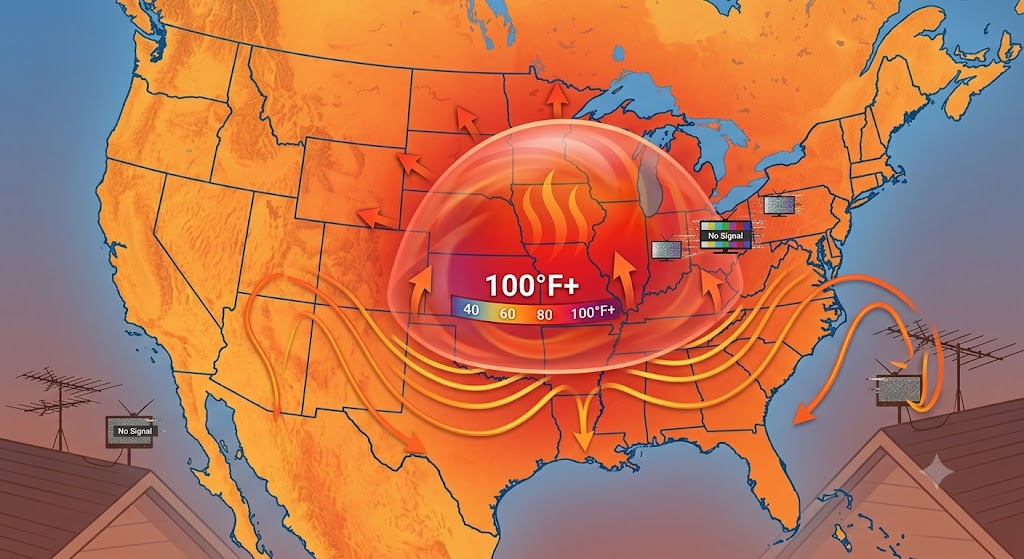
DECATUR, Ind. — No Antenna TV today?
The trouble is not in your set. It is much, much bigger.
If your local over-the-air television channels are suddenly glitching, freezing, or showing up as “No Signal,” you can blame the atmosphere. A massive summer heat dome sitting over the Midwest is doing more than just driving up electric bills—it is actively warping local television and radio signals, leaving viewers and broadcasters across the region in a high-tech bind.
The culprit is a weather-induced phenomenon known as tropospheric ducting.
Tunnels in the Sky
Under normal weather conditions, the VHF and UHF radio waves that carry digital television signals travel in straight lines, eventually passing through the atmosphere and heading out into space.
However, the intense heat, high pressure, and heavy humidity associated with the current heat wave have created a dramatic atmospheric inversion layer. This occurs when a cool layer of air is trapped close to the ground beneath a thick blanket of hot, dry air.
This stark boundary acts like an invisible, two-sided mirror in the sky. Instead of escaping into space, broadcast signals from hundreds of miles away are hitting this boundary and bending back toward the Earth.
The result is a “sky tunnel” that allows TV and radio waves to travel incredible distances, completely bypassing the curvature of the Earth.
When Frequencies Collide
While “free long-distance signals” might sound like a bonus, it is wreaking havoc on local television reception.
Because many television stations across different regions share the same broadcast frequencies, runaway signals from hundreds of miles away are crashing directly into the signals of local stations.
With old analog television, this type of interference merely caused a fuzzy, “snowy” picture. In the modern digital TV era, however, tuners operate on an all-or-nothing threshold known as the “digital cliff.” When a distant signal interferes with a local one, the TV tuner cannot decode the data, leading to sudden pixelation, stuttering audio, or an abrupt “No Signal” screen on a viewer’s favorite local channel.
The atmospheric ducting has grown so severe in parts of Northeast Indiana and Ohio that it has even caused bizarre real-world malfunctions, such as accidentally triggering local outdoor emergency sirens by carrying activation radio frequencies from hundreds of miles away.
What Viewers Can Do
Broadcasters and meteorological experts advise frustrated viewers to exercise patience rather than immediately reaching for their remote controls.
-
Do Not Rescan: Viewers are strongly urged to avoid running an automatic channel rescan on their TVs. If a TV is scanned while a local channel is being blocked by interference, the tuner will delete that station from its memory. Once the weather settles, the TV will have to be scanned all over again to restore it.
-
Wait for the Cool Down: Tropospheric ducting is highly dependent on temperature shifts. The interference is typically at its worst during the late evening, overnight, and early morning hours when the air near the ground cools while the air aloft remains warm. The “ducts” often collapse during the heat of midday, allowing local signals to return to normal.
For now, viewers will simply have to wait out the weather. Until the heat dome breaks, the ultimate remote control belongs to the atmosphere.